Jeff Bezos Stories
Insights from and encounters with the Amazon founder, before he got buff and bought a mega-yacht

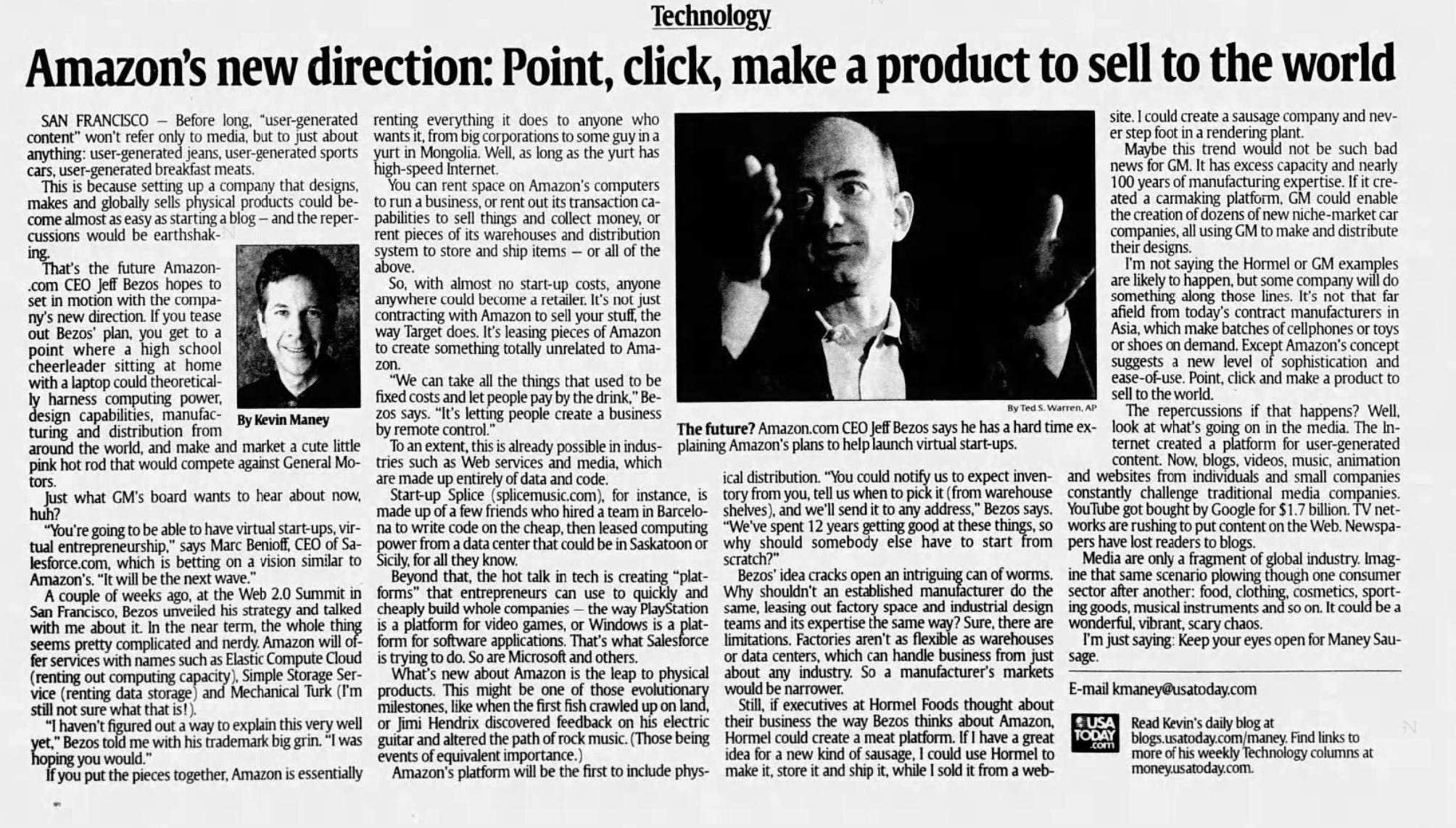
I had a good journalistic relationship with Jeff Bezos in the early 2000s. I interviewed him many times. In 2006, he tried explaining a preliminary version of AWS as we talked in a San Francisco hotel suite above a tech conference. After a while, he grinned at me and said: “I haven’t figured out a way to explain this very well yet. I was hoping you would.” I ended up writing a column that concluded: “Amazon is essentially renting everything it does to anyone who wants it.”
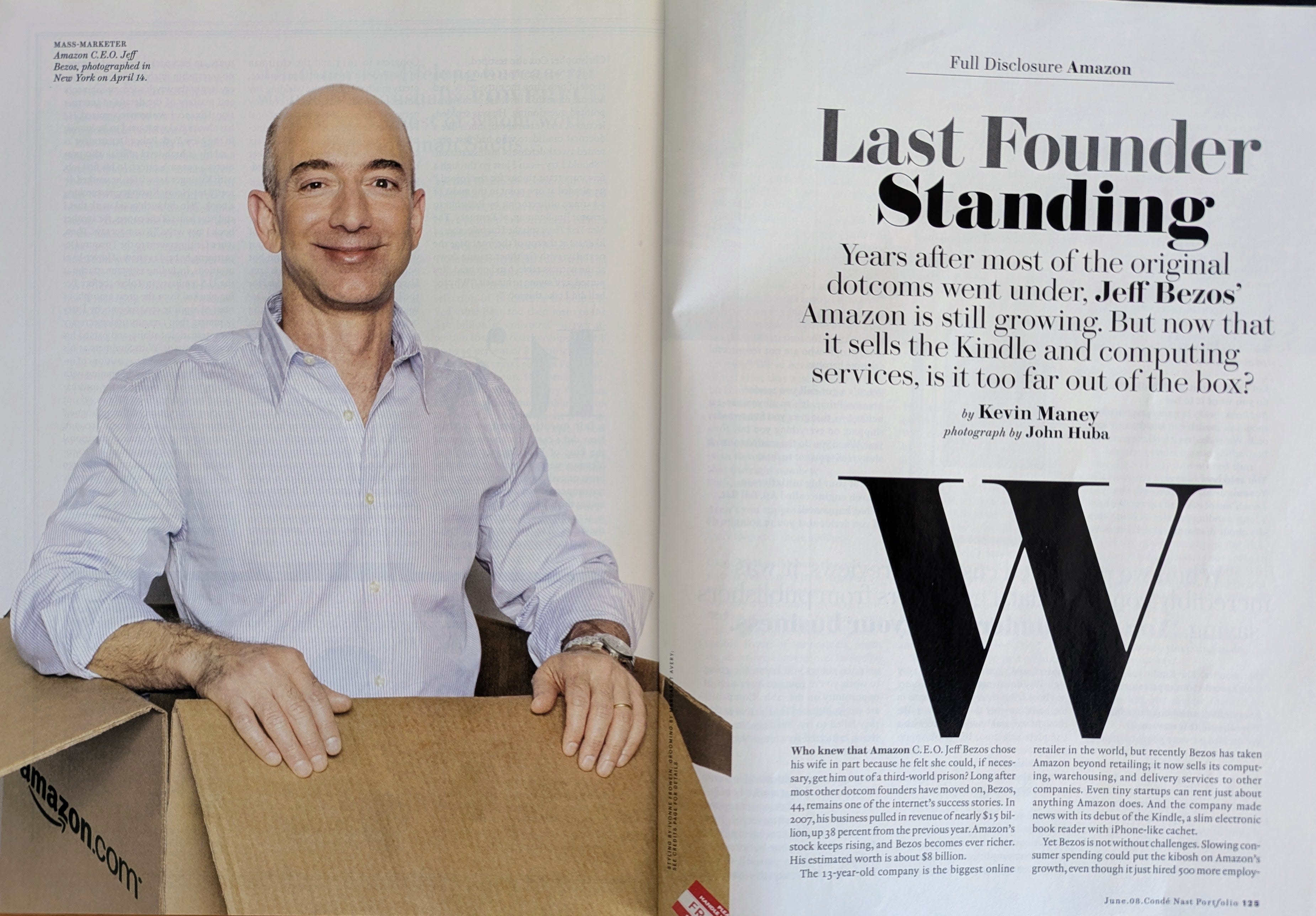
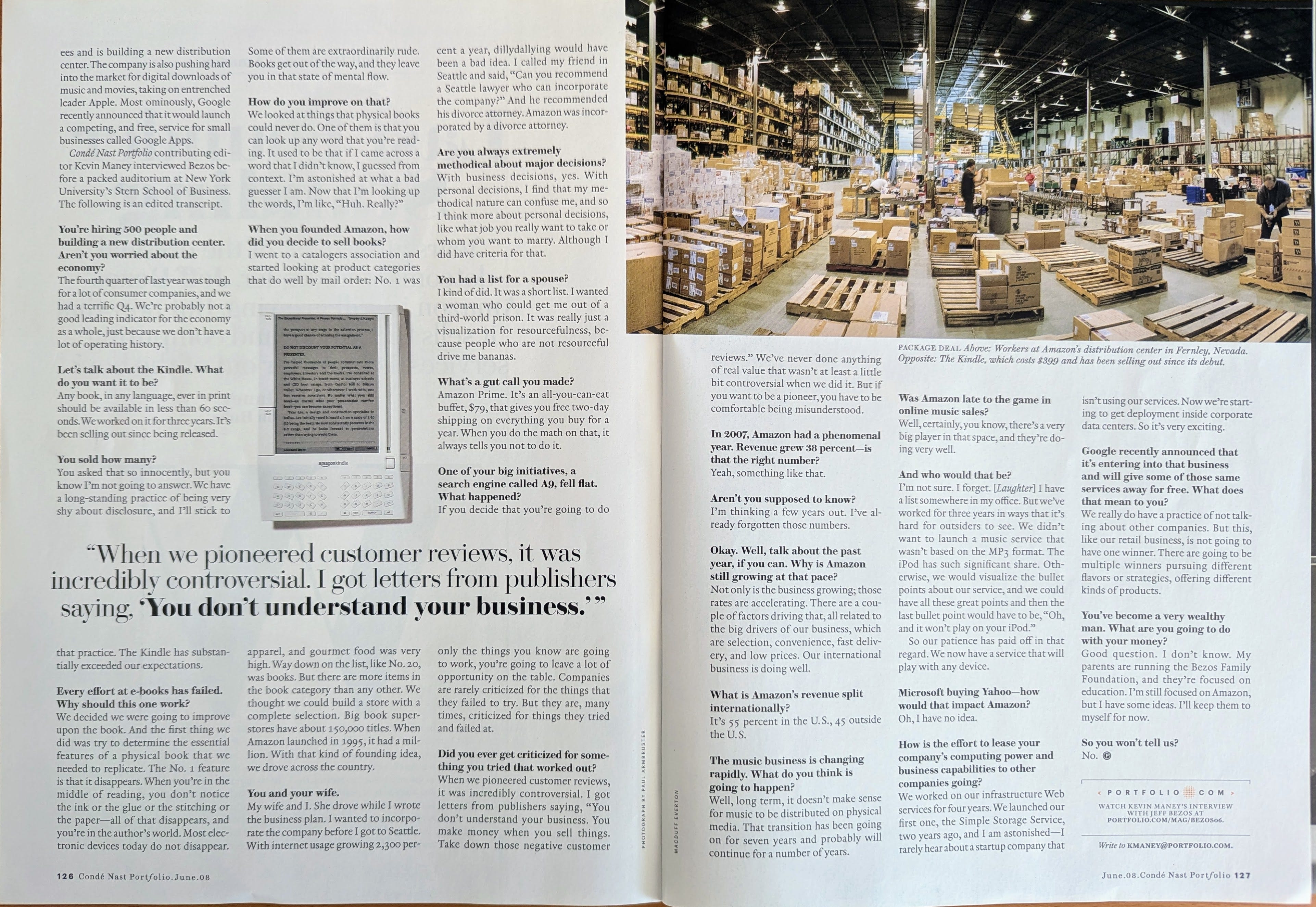
A couple years later, we had a deep-dive discussion at Conde Nast headquarters in New York about how Amazon developed the Kindle. That interview went into my 2009 book Trade-Off. Around the same time, I interviewed Bezos on stage before a packed auditorium at New York University.
The last time I saw Bezos was October 2016 at an annual meeting of The Business Council in Los Angeles. It was a super high-end affair. Most of the attendees were Fortune 500 CEOs. David Byrne of the Talking Heads was a speaker. Rex Tillerson, then Exxon’s CEO and not much later Trump’s first Secretary of State, attended. (Tillerson allegedly said in a cabinet meeting some months later that Trump was a “fucking moron,” and when Trump fired him, Trump called Tillerson “dumb as a rock.” The only thing I can say about Tillerson is he apparently wasn’t a great Exxon CEO. Exxon stock lagged behind the energy sector during his tenure.)
As that Business Council event wound down one evening, I found myself around a table with Bezos and a handful of other CEOs talking about the upcoming 2016 election and how they were all certain Donald Trump was going to lose. Then Bezos hosted the concluding party for conference attendees at his LA mansion. Next door — which was actually far away, since we’re talking LA mansions — another rich person was hosting a fundraiser for Hillary Clinton. Through the trees, we could hear Elton John playing there.
Anyway, it’s been a ten-year hiatus since I last encountered Bezos in person, and at this point all I know of the present-day version of Jeff Bezos is what I get from the news. And that version of Jeff Bezos seems at least outwardly different from the version I knew and enjoyed talking to. He used to be wiry and geeky, not buff. He didn’t own a $500 million mega-yacht. He certainly was no fan of Trump.
He was then married to MacKenzie Scott, and in the NYU interview, when I asked, “Are you always extremely methodical about major decisions?” he replied, “With business decisions, yes. With personal decisions, I find that my methodical nature can confuse me, and so I think more about personal decisions, like what job you really want to take or whom you want to marry. Although I did have criteria for that.”
I followed up and asked if he had a list for a spouse. He said: “It was a short list. I wanted a woman who could get me out of a third-world prison. It was really just a visualization for resourcefulness.”
I’ve never met Bezos’ current wife, former TV news anchor Lauren Sanchez, but she flies helicopters and wants to go into space, so maybe she’d don Ninja gear and wrest Bezos from a Houthi jail cell.
Coincidentally, the year I last saw Bezos — 2016 — was the year that Play Bigger, a book I co-authored along with Al Ramadan, Chris Lochhead and Dave Peterson, was published. Play Bigger popularized a concept that we dubbed “category design.” The book has been a huge success and led to me co-founding a firm that has by now led dozens of companies through the category design process.
As I’ve studied category creation and design, and looked for success stories to tell to describe it, I’ve often drawn on conversations I had with Bezos. Bezos didn’t call what he did “category design,” but he was a natural at practicing it.
The origin story of Amazon, and how Bezos decided to sell books as a starting place, is a terrific example of someone understanding the changing context in society and business and finding an opportunity to create something entirely new within that context. Same with the Kindle story. And I often refer back to Bezos’ reasoning for why incumbent companies have to constantly attempt to create new categories of products and services, because I believe more large companies should think that way.
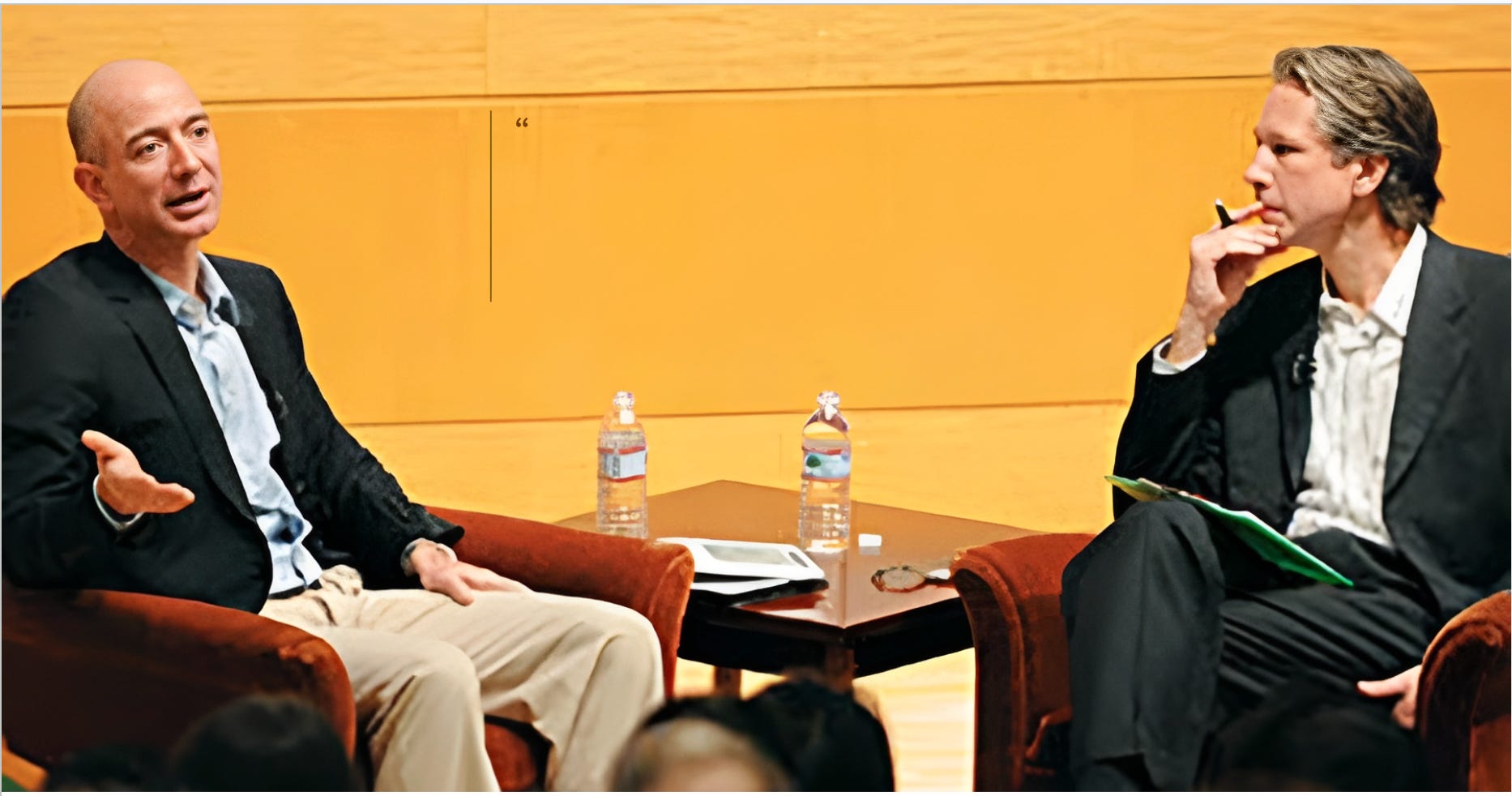
Bezos discussed all of that on stage at the 2008 NYU event. More than 400 people crowded into the theater. Bezos was animated, engaged and funny. He had the audience laughing along with him quite a few times.
I saved the transcript from that interview. A highly edited version ran in the June 2008 issue of Conde Nast Portfolio. Here, though, are a few of Bezos’ stories, unfiltered:
Amazon’s origin
Sometime in the spring of 1994 I came across a fact that web usage was growing at 2300 percent a year and as far as I know these statistics were only available on the web. So if you weren’t on the web in the spring of 1994, you probably wouldn’t have come across these statistics and it was, actually, impossible at that time to measure baseline usage of the web just because of it’s decentralized nature.
But you could, by watching packets go through certain critical points on the Internet, you could ascertain the format of the packets and you could, sort of, measure growth rates even without knowing the baseline usage. And there was a guy doing that back in 1994 and It was astonishing.
I had never seen anything growing 2300 percent a year and so the question for me was what kind of business plan might make sense in the context of this growth? And, for sure, many people had already noticed this growth rate and there were a lot — you know, Netscape was already a fully-formed corporation. I think it was called Mosaic, at that time. And there were lots of ISPs who had noticed this growth rate and other things, so lots of companies. But there was very little e-commerce and that was really what I set my sights on.
Me: How methodical were you and how did you get to books, for example?
Well, I made a list of 20 different products. I went to the Cataloger’s Association and started looking at product categories that do well by mail order. And the number one product category that does well by mail order is apparel, and gourmet food is very high on the list.
But way down on the list, like number 20 on a list of 20, was books. And the reason books were on the list at all was because of the Book of the Month Club. They weren’t really even – they were mail-order but not what I was envisioning, not a catalog of products, per se.
But the more I thought about it, I started reordering this list by different criteria and one of the things that stuck out was that the web was such a primitive place at the time. Everything broke all the time. The browsers were buggy, you know, we were all using — although, I’m not even sure if we were up to 56k modems at that point. I can’t remember. Probably 26k modems and so it was slow and when you’re in that very early period of something new, if you can do something in the more traditional way, it’s usually better to do it in the more traditional way.
And books were very unusual in one respect and that’s why they were chosen as the first best product for Amazon to sell and that is that there are more items in the book category than there are items in any other category, by far. So there are millions of active books in print around the world at any given time and online. You could not build a store with complete selection. You know, in big book superstores have 100,000, really big ones may have 150,000 titles.
When Amazon launched in 1995, it had a million titles in its online catalog. So you could really excel at that dimension and make it possible for people to find the obscure in a way that you could never do in a physical bookstore.
So with that kind of founding idea we (he and his then-wife) did drive across the country.
Taking chances on new categories
One of the things we wrote about in our 1997 shareholder letter is that we are going to be bold with our experiments and some of them aren’t going to work. If you know they’re going to work they’re not experiments. And if you decide that you are only going to do things that you know are going to work, you’re going to leave a lot of opportunity on the table.
And companies are rarely criticized for the things that they failed to try. And they are, many times, criticized for things they tried and failed at.
And that’s one of the reasons, if you want to be a pioneer, you have to get comfortable being misunderstood. In some ways it’s a much more pleasant life, probably, we wouldn’t know from personal experience, to not — you know, once you have something good just to hone it and hone it and hone it and not try anything new.
The reason and, actually, this is a very important point, people have said, “Why the heck? Amazon doesn’t know anything about building hardware devices, why the heck have you done this?” I’m really glad it’s selling well because, you know, it’s easier to answer that question.
But many companies fall prey to extending their businesses only along the lines of the competencies so it’s very easy to extend along competency. If you say we’re really good at something, let’s do more of it. But it’s not sufficient and we supplement it with looking at who our current sets of customers are and saying, “What do they need?” It’s a customer-needs focused form of strategy generation.
And if customers, you know, I could look into the future, I don’t think it’s very hard. I don’t know when it’s going to happen but I know that even though books have resisted change for 500 years, it makes sense for some of the reasons we’ve been talking about, get any book in 60 seconds, wirelessly, wherever you happen to be, lying in bed, that’s the important one that I forgot to tell you about.
It’s our vision, you know, any book but if you see that on the horizon you say, “Well, if we want to build an integrated service and part of that integrated service is a hardware device then we better get busy learning the skills that we need to be world class at hardware devices.”
And of course, you don’t do that from scratch you go out and hire world class people who’ve already done it and stepped in the right, sort of, potholes. But there are organizational and institutional competencies, too, that have to come up with time if you want new competencies and new skills.
Kindle story
We decided we were going to improve upon the book. And the first thing we did was determine what the essential feature or features are of a physical book that we needed to replicate.
And the number one feature of a book is very hard to notice, actually, and the number one feature of a book is that it disappears. So when you’re in the middle of a book, reading, you don’t notice the ink or the glue or the stitching or the paper, all of that disappears and you are in the author’s world.
Most electronic devices today do not disappear. They’re actually front and center. Some of them are extraordinarily rude. I had a microwave oven that when it was done, it beeped at me once a minute until I opened the door. I couldn’t believe who thought that was a good idea. Really, like I can re-boil the water again later. Stop beeping at me. I call devices like that self-important devices and I find them shockingly annoying.
But books get out of the way and they leave you in that mental flow state with the author’s work.
And so we knew we had to emulate that feature. But we also knew that we shouldn’t try to emulate every feature of a physical book. That is the wrong path and I’ll give you an example by analogy.
From the early days of Amazon, I was asked dozens of times in the first few years of Amazon’s existence, “How are you guys going to do electronic book signings?” And we never did figure that out. You know, and the question is a tempting one because, you know, you want to be inspired by physical bookstores in ways of thinking about what Amazon.com can and should be.
But if you get too literal with that it ends up not working because you have to play to the strengths of the new medium, whatever that is. And electronic book signings just don’t make a lot of sense or if they do, you know, we haven’t invented that yet. If somebody in the audience knows how they make sense, I’ll give you a job. I’d be interested.
So that is a very hard thing to do but you have to look for new things that could never be done in the old medium.
I mentioned customer reviews already which don’t make a lot of sense in a physical bookstore. Some of our discovery features, things like customers who bought this item also bought this, this and this. That would not be easy to do. There are a lot of things that can only be done.
Three years ago we said we have to make sure the device gets out of the way just like a physical book so you can lose yourself, but at the same time you’ve got to find some things that you could never do with a physical book and we have to do those things amazingly well.
One of the things is using this electronic ink display. It allows for there to be no eye strain. You know, the eyes don’t do that well with collecting light. If you have a backlit display, light coming through the device and ambient light, over time, that causes eye strain.
That’s why I like my Blackberry. I get value out of my Blackberry. I’m on email all the time. I’m a heavy email user. It’s a very valuable tool for me. But I don’t want to read a 300-page book on my Blackberry. You know, laptops have problems. They get warm and your hands sweat a little bit. They’re too heavy.
Kindle had to weigh less than a paperback book because one of the things that takes you out of the flow state is if your hands get fatigued. You had to be able to hold it in both hands and change hand posture because you’re reading for multiple hours at a time. There were a bunch of little things that had to be done to get Kindle to disappear like a physical book.
And then on the other side of that — the balance where you’re looking at things that physical books could never do, we found many of those. One of them is that you can look up a word that you’re reading. It used to be that if I came across a word that I didn’t know or I wasn’t sure of the meaning, I guessed just from context. I’m sure everybody in this room does that from time to time. And I’m astonished at what a bad guesser I am. Now that I’m looking up the words I’m like, “Huh. Really? I see.” And so that’s a little thing but it’s one that could never be done.
Changing the font size. I read on the treadmill and being able to change the font size on the treadmill is very, very useful. When I take margin notes on my Kindle books, all the underlinings and annotations and margin notes get stored on the server side in the cloud where I can access them and where they can never be lost.
I’ve always taken margin notes. I mostly just underline things and put exclamation points next to things and I write little notes like, “Wow,” and they’re lost. I mean they might be in my library somewhere but I can never find those passages again. Not without a lot of work.
Oh, I forgot the most important one is that it has broadband wjre!ess built in with a business model that has no monthly service plan. So when we looked at, you know, trying to make this device convenient and get it out of the way, it’s very easy to figure out one of the things that consumers hate about wireless devices. They hate having a multi-year contract or even a one-year contract and they hate having monthly, you know, $40 a month for a data plan of some kind.
So we changed that whole business model and when you buy the kindle, when you buy content on the Kindle we need to cover the cost for the wireless transmission into the cost of the content itself. So most books on Kindle are $9.99 and that is, you know, a very attractive price point.
There are many differences, I mean, this is the first time that anybody has ever said, “Let’s try charging less for the e-book than for the physical book.”
And you know customers won’t pay the same for an ebook that they will pay for a paper book and I don’t blame them. It’s, you know, they know that there must be a lot of cost reduction in that system so why should they be charged the same?
—
This is the interview as it ran in Portfolio. It doesn’t seem to be available online. Below that is the column I wrote about what would become AWS.